Claude and Fermat's Last Theorem: What AI-Assisted Formalization Actually Means
Claude, Lean, and Fermat's Last Theorem are part of a larger story about machine-checkable mathematics. Here is what the claim means—and what it does not.
Anthropic's official September 4, 2026 research announcement says Claude has helped produce the first complete computer-checked proof of Fermat's Last Theorem.
Claude worked largely autonomously for 11 days. During that run, the project produced about 13 million lines of Lean, proved roughly 30,300 intermediate theorems, and used about 29,500 of them in the final proof. Dozens of Claude agents collaborated through Prove2Me, a platform designed for machine-checked mathematical work.
Anthropic describes the internal research model used for the project as roughly comparable to Claude Fable 5.1. The finished proof was checked by Lean.
The result deserves careful framing. Claude did not discover Fermat's Last Theorem. Andrew Wiles, with Richard Taylor's help, proved the theorem in the 1990s. What is new here is the formalization and verification of known mathematics: translating the proof into Lean so a computer can check the completed argument step by step.
This is not the same as discovering the theorem
The headline matters because the wording matters.
Claude did not discover Fermat's Last Theorem. It did not turn a previously unknown conjecture into a theorem. The mathematical result was already known; the challenge is expressing a very long proof in a formal system without leaving gaps that a human reader might silently fill in.
That is why “formalized” is the important word. It describes a verification workflow, not a new mathematical discovery.
Why Lean formalization is difficult
In ordinary mathematics, a proof can compress several familiar steps into one sentence. Readers use context and experience to reconstruct the missing links. Lean is less forgiving. Definitions, assumptions, types, lemmas, and dependencies have to line up in a way that the kernel can verify.
The project follows the Wiles–Taylor–Wiles route. Its goal is not to re-prove whether the theorem is true, but to build a machine-checkable version of the proof and its supporting mathematics. Anthropic's announcement describes how Claude's agents used Prove2Me to break that work into smaller formal tasks, share intermediate results, and submit Lean code for checking.
That distinction is useful for anyone following AI-assisted reasoning. A fluent explanation can sound complete while hiding a missing step. A checked Lean proof gives you a much stronger signal about whether the formal object actually type-checks.
What the result actually verifies
The important artifact is not the model's explanation of the proof. It is the Lean code that compiles under the project's stated environment. Lean checks the finished formal object and rejects a proof with a missing or invalid step.
That gives the result a stronger reliability signal than a polished natural-language answer. It still does not mean every line of generated code is insightful, efficient, or easy for a human mathematician to read. It means the final formal proof satisfies the rules of the Lean system used to check it.
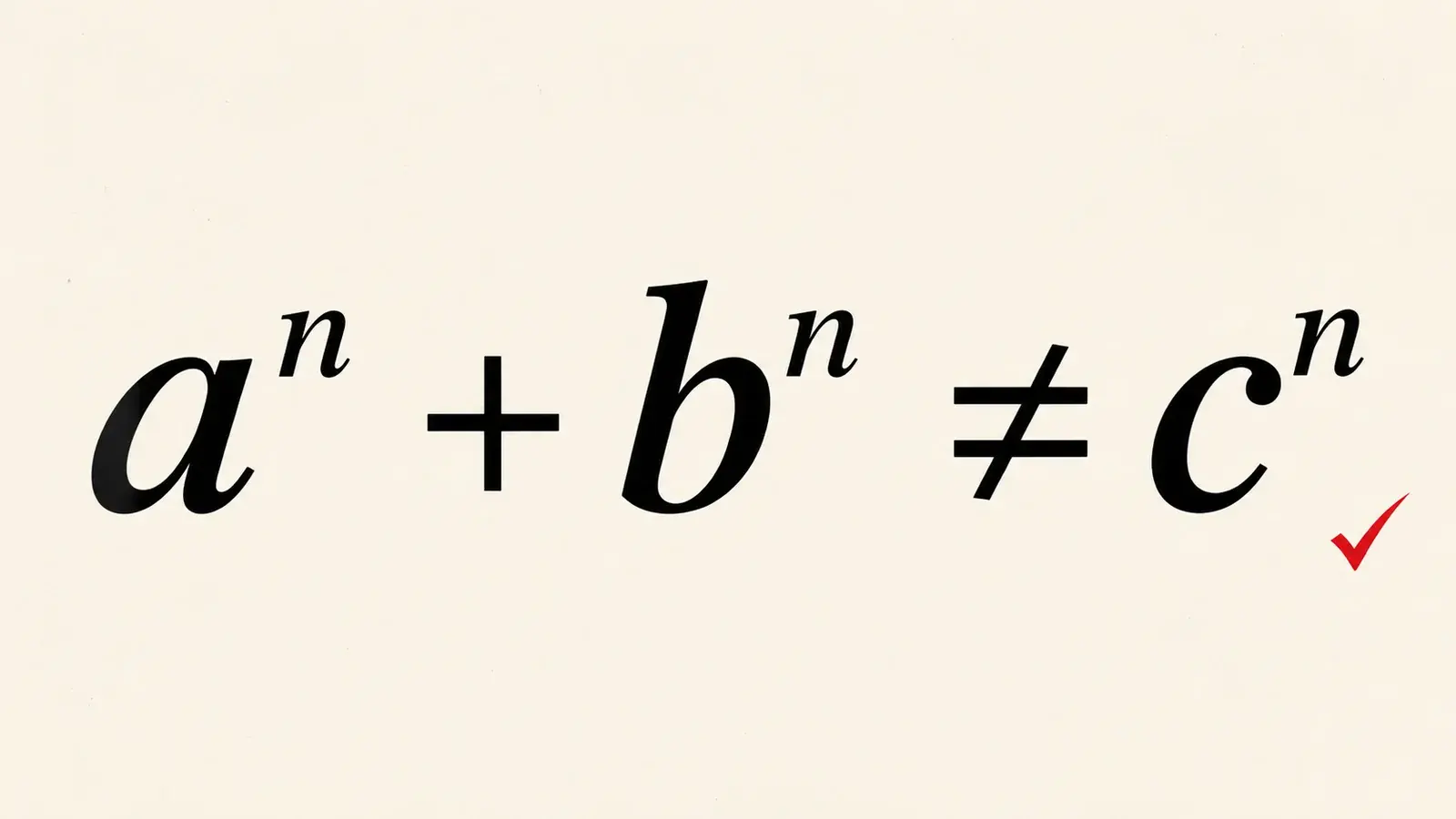
The Lean mathematics library's Fermat documentation explains the theorem's formal statement, while Anthropic's announcement documents the new Claude-assisted completion.
Why the story matters to developers
Formal mathematics is also a useful lens for software engineering. In both settings, “looks plausible” is weaker than “passes a strict check.” The same direction points toward better code generation, specification, debugging, and high-trust automation.
For a broader view of how current models are positioned for coding and reasoning, see our AI model comparison, the Claude Fable 5.1 model profile, and the GLM-5.1 coding and agentic reasoning review.
The likely future is not an AI working alone behind a curtain. It is a model proposing structured steps while a proof assistant, compiler, test suite, or reviewer checks the result.
Final thought
The interesting story here is not that a chatbot supposedly replaced a mathematician. It is that AI systems are being pushed toward environments where correctness can be tested instead of merely narrated.
The meaningful milestone is the verified artifact and the formal work Claude helped construct—not the most dramatic version of the headline. That is the standard worth carrying into every new AI reasoning claim.
Sources
- Formalizing Fermat's Last Theorem — Anthropic's September 4, 2026 research announcement and primary source for the Claude-assisted formalization.
- Imperial College London Fermat's Last Theorem project — Lean formalization project and mathematical context.
- Mathlib documentation for Fermat's Last Theorem — theorem statement and Lean context.
- Anthropic Claude Fable 5.1 — official model context.